Showing posts with label Science. Show all posts
3 com

M O D I S et A M M I N I C U L U M


IN GENERAL: Modis et Amminiculum is a project on the relationship between form and function in design, language and nature.  "The connection between form and function has been an organising principle in the sciences, arts and humanities which has emerged with increasing force since the 18th century and appears to preoccupy what I am trying to develop in this chapter."


"The most important thing in comparative anatomy is the relationship between form and function. The broader application of which enables us to develop hypotheses tracing the evolution of organisms and organs and simultaneously allows us to see our selves in a broader biological context. Functional anatomy examines the performance of structures within organisms the performance of structures within organisms, such as cells, tissues, organs, organ systems and other complex functional units." Functional Anatomy of the Vertebrates- 3rd Edition; Liem, Bemis, Walker, Grande (Brooks/Cole 2001)


Lest not forget the property of nature ‘ordinary exhibits extraordinary behaviour’ (Davis, 2009, 24), which is best understood in biological terms in the opening paragraphs of Francis Crick’s Astonishing  Hypothesis (Crick, 1993, 3):


“ T h e   A s t o n i s h i n g   H y p o t h e s i s   i s
 t h a t   ‘ Y o u ’ ,   y o u r   j o y s   a n d   y o u r
s o r r o w s ,   y o u r   m e m o r i e s   a n d   y o u r
 a m b i t i o n s,
y o u r   s e n s e   o f   p e r s o n a l   i d e n t i t y   a n d
f r e e   w i l l   a r e   n o t h i n g   m o r e
 t h a n   a   v a s t   a s s e m b l y    of   n e r v e   c e l l  s
a n d   t h e i r   a s s o c i a t e d    m o l e c u l e s ”


Albeit that Crick had some ideas that were just wrong, this particular statement is quite true. Anatomy is incredible, even if it is meat. The fact that a meaty, fleshy substance gives rise to digestion, articulation and thought  IS astonishing. No magic, special ingredient needs to be added to the bio-mechanical marvels that we catergorise as living, just "ordinary matter exhibiting extraordinary behaviour". I think it worth mentioning that although James Watson and Francis Crick are credited for the discovery the structure of DNA British biophysicist and X-ray crystallographer Rosalind Elsie Franklin, made invaluable contributions to the discovery. At the time, this went largely unnoticed. Probably because she was a woman.

Since January 2011, I have been drawing in Dissecting Room (DR) at St George's University (Hospital in Tooting...). The bodies I have drawn were donated for anatomical examination under the Human Tissue Act (2004) and consent for images to be taken was given. Such a rare opportunity, not only for myself but especially for medical students is a great privilege. The utmost care and respect is given at all times in the DR, and all who attend and teach at Saint Georges are sincerely grateful for the generosity of donors and their families.

 This experience, including what the students and faculty have taught me has encouraged me to take a closer look at anatomy and in brief- consider what concerns form and function.  with considering to what is lost and what is gained from different forms of representation: What anatomical commonalities are represented and HOW do schematised illustrations and/or abstract symbols correlate with descriptions of a physical principle. The logical properties of such representations reflect distinct relationships in anatomy, thusly accounting for discrepancies and succeeding in clearly describing nature. On the other hand it is also relevant to consider that the impression made on our senses when observing nature directly. There is a physical sense associated with this concept, reminiscent of Descartes. When one draws from you life, one draws 'how things are' (although via the subjectivity of penmanship).
These different forms of representation, vary in their verisimilitude but both succeed in describing aspects of anatomy. A lot can be gained from simple observation however Descartes error is clearly defined when we deduce that observation alone is not enough to guarantee understanding.....something along the lines of  DAVID HUME'S admission that inference does not lead infallibly to truth. One can not rely on re-occurrence of a particular process or structure in nature (take the rising of the sun for example) to guarantee that this event will keep happening forever (knowing involves definitions- 'what is happening? and how?'). We need to know what the pattern is and how it works if we want to make the kind of statement; 'the sun will rise every day until I die'. (This is only really true for a limited about of lifetimes anyway- so imagine just one lifetime for the example to be true so we can simplify the point).  Such a statement is only reliable if the process behind it is understood and the 'form' (i.e the theory- which in this example are the laws of planetary motion, the Newtonian approximation-special relativity and Einstein's theory of general relativity)  is repeatedly matched to observation (matched to a pattern- maths or an image).  Only then can you say- this effect 'the sun will rise every day until I die', can be shown to be a real thing- A correlation beween experience and concept.

Concerning Hume's admission "inference does not lead infallibly to truth", the publication containing the research of this endeavour considers a variety of illustrated facsimiles of works from the likes of Paul Churchland and Paul Feyerabend which highlight how the physical nature of the mind; sensory perception and 'psychological experiences' provide unreliable evidence. And although beliefs/culture and convincing sensory and emotional inputs may protest to this adversity; protest that 'this is what I feel', 'but, this is what I saw, I definitely saw this....'-  How do you KNOW? We might question adversely. How do you know what you saw? How do you know that what you saw was what you saw? Again, Betrand Russell ties this up nicely- "If a man is offered a fact which goes against his instincts, he will scrutinize it closely, and unless the evidence is overwhelming, he will refuse to believe it. If, on the other hand, he is offered something which affords a reason for acting in accordance to his instincts, he will accept it even on the slightest evidence. The origin of myths is explained in this way".


A N Y W A Y- Here is some stuffs what I have made! (AND Here is a nice lecture: IS ANATOMY DESTINY? )

Im going to post up my reading list next time!

Embossing for the cover of the publication

Screen prints about the GallBladder. Linin, dyed linin, flock, mineral pigment and gloss medium


Some etching plates, the plates used to emboss the cover and the tops of some plates with ceramic prints.

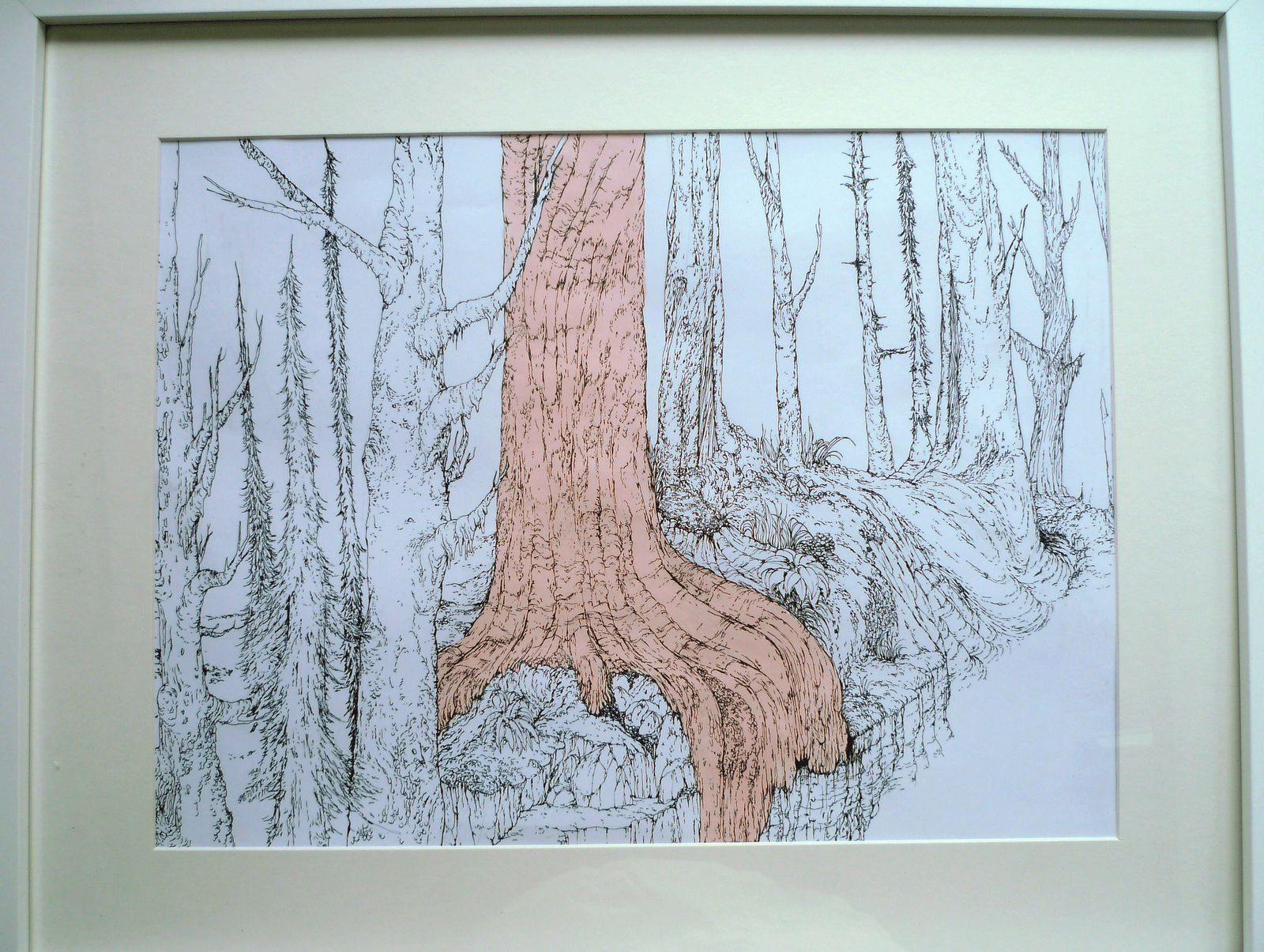
Framed drawing from the DR

Since January 2011, I have been drawing in Dissecting Room at St George's University (Hospital in Tooting...). The bodies I have drawn were donated for anatomical examination under the Human Tissue Act (2004) and that consent for images to be taken was given. 

Crockery and ceramic transfer print. 


0 com

Things to come apparently

For now, lets remain ambiguous. Many thanks to Saint Georges University for their immense knowledge and wisdom!


Teeth and Salivary Glands
section of small intestine and ascending colon
Stomach lining


0 com

The Unperturbed Kilogram

So who is this KILOGRAM anyway?
 
http://physicsworld.com/cws/article/print/44445
0 com

BACK TO THE SPACE SUIT!

Vincent Fournier's spectacular photography in SPACE PROJECT: http://www.vincentfournier.co.uk/main.html

GAH! THIS PLACE. Next time I am in Norway, I am going here: http://kho.unis.no/. The Kjell Henriksen Observatory. The only reasonable way of accessing Svalbard is by airplane.


OBSERVATORY POSITION:
  • 78o 8' 52.8'' N, 16o 2' 34.8'' E 
  • GEO: 78.148 N, 16.043 E
  • ALTITUDE: 520 m


All these images are from the KHO website: http://kho.unis.no/


0 com

Tyngs seldom thought: Briefly, Kelvin on Kant (1897)

Kant pointed out in the middle of last century, what had not previously been discovered by mathematicians or physical astronomers, that the frictional resistance against tidal currents on the earth's surface must cause a diminution of the earth's rotational speed. This immense discovery in Natural Philosophy seems to have attracted little attention,--indeed to have passed quite unnoticed, --among mathematicians, and astronomers, and naturalists, until about 1840, when the doctrine of energy began to be taken to heart.

—Lord Kelvin, physicist, 1897


FUUUUCCCKKK! Is this not wonderful? How intuitive of Kant....Is this fact obvious? Worth communicating?.....Next time I am in the sea this will pre-occupy me.
0 com

GLANDS

Which are made up of cells: Around each cell, cell membranes hold in the organelles, they do it well.

SLIDES Source: http://biology.clc.uc.edu/Fankhauser/Labs/Anatomy_&_Physiology/A&P202/Endocrine_System/Endocrine_Histology.htm


IV. Adrenal Gland, 100x:  Slide 16, Adrenal gland, cortex (& medulla?) 
labeled 40x view of the adrenal gland.

labeled 40x view of the hypophysis (pituitary gland).  Hypophysis, 40x: Slide 14, Hypophysis, pars distalis, intermedia & nervosa, cat, H&E, 
0 com

THE SPACE SUIT AND THE TOILET (mild appreciation of)

I will be brave (or ignorant) enough to assume the following: People think about space suits.

I am not keen on assumptions, but being idealistic and a human that often thinks about space, I LIKE (enjoy or take pleasure in) assuming that most people develop or at least consider developing an intrigue in the unknown. I hope that this statement is not too ambitious or too idealistic. Amongst the many things being unknown to our kind, SPACE is one of them. I am quite sure that many people think about space - as in the space what is intergalactic etc.

I would like to assume, for now, that perhaps people also contemplate space suits. Ill even be so bold as saying that people consider the practical feasibility of 'dressing-up' as in 'fancy dressing-up', as an astronaut.

Following a discussion about space suits with a friend of mine, I decided it was worth more consideration. It is not just a costume, although a mighty costume it be. With barely over half a century of scientific prelude and development, on July 20 in the year 1969 AD, NASA's Apollo 11 became the first manned mission to land on to the surface of our Moon.

About being naked in Space: 
  • One does not explode, 
  • One's blood does not boil- the containing effect of your skin and circulatory system keep your tissues together, 
  • Nor does one instantly freeze, even though Space is typically very cold, less than 3 degrees above absolout zero (+/-3K on the Kelvin scale or −270.15°C ). 
  • One will however quickly become unconscious after the body's dangerously depleted oxygen supply in the blood reaches the brain and unprotected skin is likely to suffer burns once exposed to the intense ultraviolet radiation of direct sunlight. Humans are not inhabitants of the vacuum, outer space is most inhospitable. You would die quickly, and funnily enough holding your breath before entering a vacuum will do you great damage (think pressure difference).

Barely over half a century of relevant technology and research lead to its production. How fawn-like it will look to the future! Compare this to how long it took for people to accept that the world was round. It took far too long! This does not inspire me with confidence, although  in reality, largely to blame in this retardation of understanding are those who obliged people to follow and not question moral/educational authority.

If it were flat, then all the shadows on the whole surface of the entire world would always be the same length at the same times throughout the year. And such is NOT the case (Carl Sagan illustrates this beautifully in one of the episodes of the COSMOS tv series first broadcasted in 1980). Humans have been writing and traveling for thousands of years, many thousands  enough to have shared and compared calendars and have initiative to inscribe observations of the natural world and compare these also. Seeing as it IS observable in many ways, I'm sure more people KNEW the earth was round, but were not allowed to talk about that. That is a terrible thought.

What else is amazing? SEWAGE! Here is another  assumption: Which assumes (stupidly and ignorantly perhaps, I do know any facts) that the vast majority of people living in large cities across the world have seen, or at least heard of a toilet. Baring in mind that there are,  both in existence and in use a vast variety of effective toilet and irrigation designs.
Where ever it was, who ever, which ever organisation or collective and when ever they lived who were among the first toilet/sewage designers and builders, well done! Very handy development. More sewage systems please! Unfortunately I  can not digress into environmental issues, another time maybe, when I know more and feel like vomiting again, this here merely be 'bigging up' the concept of water sanitation, it is wonderful. May sewage systems become more efficient and safe for all!

Sewage Systems and Space Suits! And Space Suits with Integrated Sewage Systems!

0 com

Into the unknown

CLICKY HERE: http://arxiv.org/abs/1008.2461 

Search for New Particles in Two-Jet Final States in 7 TeV Proton-Proton Collisions with the ATLAS Detector at the LHC.

  
Into the unknown
0 com

Feynman, you are a fine man!

Broadcast about Richard Feynman!


http://www.bbc.co.uk/iplayer/episode/b00ts5mm/The_Archive_Hour_The_Feynman_Variations/
0 com

The Taylor Glacier, Blood Falls and Europa

Antarctica's "Blood Falls", was initially thought to be red algae.  But its spewing red because of ferrous ions in water coming into contact with oxygen. Ions of iron, were originally dissolved in what became an isolated pouch of ancient seawater (the former Antarctic Ocean) which was trapped below the Taylor Glacier during the Miocene period about about 23.03 to 5.332 million years ago- a time not-as-long-as-it-seems-ago in terms of geology; flowering plants were around accompanying the long-beaked dolphin Pomatodelphis and our modern shark. 

This isolated water pouch, which is the source of blood falls, contains a very high concentration of salts (brines) and is described as a hyper-saline solution. It is; oxygen free- due to physical and chemical mechanisms at work progressing from this isolation, rich in chlorides, rich in sulfates- association with marine conditions and rich in ferrous ions- signaling microbial activity in the water and sub-glacial bedrock and its extremely dark and cold. This sub-glacial ecosystem is a very unlikely place to find life considering these harsh conditions, Extremophiles are organisms adapted to such extreme conditions. This makes it an interesting place to study when pondering over evolution and genetics and even speculating where else in the universe life could be found. Like Europa for example; Europa is one of Jupiter's moons, primarily made of silicate rock with a likely iron core. Europa has a feeble atmosphere containing a significant percentage of oxygen, and a thick crust of ice- suggestive of extreme types of 'sub-glacial' water pouches, oceans even. But it has yet to be proved/disproved if there in exists any bacterial life- or life of any description at all. Its very unlikely.

Possibly something worth engineering? Perhaps not? Who knows?

Actually, why not?

ANYWAY, when these soluble ferrous ions come into contact with atmospheric oxygen they  are oxidized (surprisingly) and iron oxide has this rusty pigment you will probably recognize.


An outflow of an iron oxide-tainted plume of saltwater, occurring at the tongue of the Taylor Glacier onto the ice-covered surface of West Lake Bonney in the Taylor Valley of the McMurdo Dry Valleys in Victoria Land, East Antarctica. (via wikipedia)
0 com

Holes?


0 com

Talksy

Oliver Sacks on visual and audial hallucinations:
http://www.ted.com/talks/oliver_sacks_what_hallucination_reveals_about_our_minds.html 

Also this one: (It would seem, there IS hope for our festering minds!)
http://www.ted.com/talks/michael_merzenich_on_the_elastic_brain.html


0 com

The Breiðamerkurjoumlkull Project 1964-67 and Breiðamerkurjoumlkull Revisited (1998)

One day I will do a survey!

AMAZING  images of Glacial Geomorphology (at Glasgow) from: www.informaworld.com
http://www.informaworld.com/smpp/section?content=a917472007&fulltext=713240928


0 com

Some offe my work for The Exhibition


And more of the show can be seen over HERE! http://thewholeuniverseinaglassofwine.blogspot.com/2010/06/blog-post.html


0 com

EOL NASA: The Gateway to Astronaut Photography of Earth hosts

http://eol.jsc.nasa.gov/


0 com

The Whole Universe in a Glass of Wine PRESS RELEASE: Exhibiting on 4th June 2010 at THE GALLER IN REDCHURCH STREET


THE WHOLE UNIVERSE IN A GLASS OF WINE is a poem by the physicist Richard Feynman. Through the use of ink, print, music, performance and film, this event reacts to his exquisite dissection of the Universe into physics, biology, geology, astronomy and psychology.

A show created and curated by


Join us for a glass of wine (or more likely a glass of cider) and enjoy the metaphor, while examining the artwork and listening to the live music and lectures.

The festivities will take place at THE GALLERY IN REDCHURCH STREET on the 4th June 2010, begin at 6.30pm till 11:30pm and will last only till the following evening. So don't miss your chance to visit! Full cosmic soundtrack provided on opening night.

Live music from JOHNNY AND THE CHEMISTS
(more to be confirmed)

Spoken word from ADRIAN HOLME and STEVEN SMYTH

Sponsored by Koppaberg Cider

0 com

Want to learn some Physics? FOR FREE?

 VISIT THIS SITE: MIT PHYSICS LECTURES with Professor Walter Lewin


Amazing.
0 com

Probability and Patterns: Vagueness beyond your standard drunken memory is nothing more than fact

This happens to be important to the concept/topic I have selected because what I am concerning myself with is has alot to do with probability.

All events occur at random through out the universe but are described as deterministic. Similarly, its is interesting to question if the constants of nature, were any different would life have emerged? Not to mention many more uncanny patterns in fractal geometry and constants such as pi and e. Needless to say, what are the chances of living in a world where the constants of nature are just right to give rise to life? Well, pretty high, considering that this is the case and the only case (so it seems) that this is possible, if the constant of nature in this universe are suitable for the emergence of life in some corner, then life will emerge- and indeed it has seeing that we can talk about it. 


Lest not be negligent however of this interesting observation: 

'Knowledge of the external world is "relative" only in the (comparatively harmless) sense that what human beings can know is restricted to  the way the human mind is organised.' (Dieter Freundlieb, 1991). 

"It is wrong to think that the task of physics is to find out how nature is. Physics concerns what we can say about nature..." (Neils Bohr)

SOOOO, lets not all fall in love with our ideas to the point of obscurity!


ANYWAY, coincidental improbable phenomena are suggestive of those which are more discrete, the discrete unlikelihoods that lie hidden in probability are the ones I am interested in. All I can definitely say is its all very mysterious and unlikely! (Yet the chances of being here must be pretty high). Probability is measurable, but probabilities change constantly when variables are subject to their own set of crazy rules. Thats why they are called random. No space for linear logic here!


Truth be told all measurements of physical quantities are subject to inaccuracy as the nature of measurement is subject to ± inaccuracies all the time. In addition to this, we have problems observing reality objectively. For instance, the 1935 paper by Einstein, Podolsky and Rosen, argued that the Quantum-Mechanical theory is incomplete; that and It can only make statistical predictions on objectively existing physical properties, ‘A sufficient condition for the reality of a physical quantity is the possibility of predicting it with certainty, without disturbing the system.’ (EPR, 1935, 1). The position and momentum of a particle (two properties needed for defining what they are) cannot simultaneously be known: ‘In quantum mechanics in the case of two physical quantities described by non-commuting operators, the knowledge of one precludes the knowledge of the other’ (EPR, 1935, 1) and ‘the scientific observer has to make a decision which to observe, playing an unwilling subjective role in determining the definition’ (Ede, 2008, 21).

Anyway, Mathematics IS all around us, we can gauge patterns from observing with our eyes such things as growth and hearing cadence patterns in music. Interpretation of the natural world is vital to our survival. The 'maths' behind these observations is immensely complicated but all of us can experience how a tree grows in some way, but a sense impression is not a guarantee of understanding. We need to know something more than what we sense. Some kind of 'objective message'. Although perhaps mathematics is the in fact a liberal art as it is not always drawn from nature but sometimes completely constructed- yet still completely real , provable and objective in what it means. Which much like ART has an independence in it 'value', you needn't understand art to appreciate it and the maths needed represent reality to 'make sense'. 


S O M E   C O N S T A N T S  
Pi: π is a constant whose value is the ratio of any circle's circumference to its diameter in Euclidean space; this is the same value as the ratio of a circle's area to the square of its radius.

e: The constant e is base of the natural logarithm. I remember asking about e when I was doing my A-Levels and I never got a good enough answer, through example we were taught about it which I think is good but I wish someone had told me in a memorable visual way that it was a constant that existed with a formidable nature: e is the unique number with the property that the area of the region bounded by the hyperbola graph , the x-axis, and the vertical lines and is 1. e = 2.71828183. Sometimes known as Napier's constant, although its symbol (e) honors Euler. (See this)

There is, as another example known as the golden ratio, which is an irrational mathematical constant much like Pi and e. I will elaborate on this constant as a pre-prelude to my selected topic. The GOLDEN RATIO is approximately 1.61803398...etc, is a line segment divided according to the 'sum of the quantities to the larger quantity' equal to 'the ratio of the larger to the smaller'. BASICALLY, It is a geometric relationship that is the midpoint between asymmetry and symmetry, when "the whole is to the larger as the larger is to the smaller", a proportion that exists as a property. It exhibits itself in many things in nature, perhaps a result of the trial and error in evolution and an example of nature's efficiency. Its an interesting constant a natural development (or emergence/design) which has lead to efficient survival of many a sun-flower (in how economically their seeds are spaced in their flower heads) as well as and beauty in some of the art and technology that humans derive. Nature is good at saving time and space- by nature! 

There is no magical life substance or super-nature that makes life happen. The universe is (some how) a result of ordinary, inert matter exhibiting 'extra-ordinary behavior' (Davis, P. (2009) The Quantum Life, published in Physics World, Vol. 22, No.7 (July 2009), pp. 24-28). The ordinariness making it even more extraordinary. It seems that energy, in what ever form it may take is self organizing; as if  connections between apparently unrelated things. 

As for objective reality it is important to introduce Bells Inequality. In theoretical physics, Bell's theorem is a no-go theorem, a paradox loosely stating that: No physical theory of local hidden variables can ever reproduce all of the predictions of quantum mechanics. So basically, it is unpredictable by nature. Unless something is observed and measured it can not be shown to exist- a fact which is objective. Weird and logical- all at the same time.

* "One of the principal features of quantum mechanics is that not all the classical physical observables of a system can be simultaneously well defined with unlimited precision, even in principle."

Even with multitasking quantum computers capable of simultaneous calculation well on their way, it seems that humans are finite, as is their intelligence. There is a limit to our knowledge, which I am frankly relieved at, this is one reason why our mortality is so wonderful.

Please visit blog entry from Wednesday, 4 February 2009: Sir Vival (Author Project: GENESIS)


One of the principal features of quantum mechanics is that not all the classical physical observables of a system can be simultaneously well defined with unlimited precision, even in principle. Instead, there may be several sets of observables that give qualitatively different, but nonetheless complete (maximal possible), descriptions of a quantum mechanical system. These sets are sets of "good quantum numbers," and are also known as "maximal sets of commuting observables." Observables from different sets are "noncommuting observables".
Einstein, Podolsky and Rosen collaborated on a paper arguing hat the quantum theory is incomplete: "It can only make statistical predictions on objectively existing physical properties"

NB: Einstein believed the world was very complex, which is true. But he affirmed that there must be an underlying law that places everything in order from its immense complexity. An order that because it follows a law, must be predicable, that there must be some kind of statistical way of predicting how it works. His view that events occurred in conjunction to some underlying order lead to his view that things 'do not just happen'- (hence the quote: "god does not play dice with the universe", to which Niels Bohr replied ''quit telling god what to do''- Not that either believed in a god-like physical entity). Interesting response. The search for the fabled theory of everything, I think lies with in probability. But what is the difference between causality and randomness if both in effect do occur? If they do then they are both measurable (even if in some cases something is being assumed to be present). In some way they both come from a physical quantity being measured or predicted and lead to a physical reality. But thats not my concern or priority.

In conclusion: I must draw some pictures and stop with these digressive ramblings!


As another digression, here is an amusing parody of one of those high-school educational programs called LOOK AROUND YOU, its ridiculous. Useless information and nonsense definitely has a place in the world. http://www.youtube.com/watch?v=Pj2NOTanzWI&feature=related


0 com

IN RECEIPT: A very thin layer of conventional thermal sensitive material

It has recently been drawn to my attention that most receipts are not printed using ink. The information displayed on most receipt paper is infact transferred onto the 'paper' which is coated with a very thin layer of conventional thermal sensitive material. The information is created by a light (heat) source 'spelling out' the information onto the surface, causing a physical fusion process to take place in the thin thermal sensitive layer part of the surface (e.g. of the receipt paper) where by the areas exposed to the light source melt rapidly and assume a change in pigmentation. The trick lies in the fact that the change in pigmentation only takes place when in liquid state and the heat makes the thermal sensitive layer change phase from solid to liquid. This change is permanent when it cools and re-solidifys, which happens quickly. The faster it cools, the more lasting the effect. The side of the paper with out the coating is left unchanged.


Anyway, this for me was astounding. I had a most exciting day playing with light bulbs, lighters, kettles and this has been right in front of me all along. People bang on about thermal transfer printers all the time and yet no penny dropped. Until now.

Here are some of the results from heat-play. Its very exciting that the backs of all these receipts remains unchanged compared to the difference that appears on the coated side.

Rubbing also marks this paper type because friction creates heat. I would like to get my hands on some massive sheets/rolls of this paper and will read up about something called 'thermochomism', the likes of which exists in mood rings and those mugs that change picture when hot beverage is poured inside. It will be of use to me.


0 com

Sir Vival (Author Project: GENESIS)

All our needs boil down to the possibility of entropy exchange on all scales possibly imaginable or real, in all possible moments of the past future and present. Truly survival is down to probability. In all its beauty, horror and exceptional outstanding surprising and heart breaking coincidental magnificence that is present between us all and with in each of us, Life is all about possible events and out comes becoming true on our time scale and the fact that we experience them.


This is the survival function or reliability function.


Which I find relevant and interesting as it is based on mortality. Which is something humans have been unwilling to accept for a long time, but really despite it's sadness and its tragic manipulation/exploitation by people in situations of strife, confusion and war, our mortality is the one natural necessity to ensure variety. Life is determined by varying between repetitions, differentiating and flexibility with in the boundaries of what is for the best. To avoid sclerosis, inflexibility and the inability to adapt when faced with uncontrollable natural forces, excessive repetition is a no-go. Needless to say, boud-less differentiation threatens the internal sense of necessity. Hence, Balance is another vital asset to our survival. It is insured by the mortality of living things and their ability to reproduce and adapt. Adaptation is guaranteed by our responses (both physical and emotional) to our changing environment that fuel growth and development.

Investigating molecular functions or processes in any living thing will probably get us closer to defining the essentials of survival. Survival is about sustaining your existence, or maintaining life/consciousness. To survive, what is necessary (in no particular order) are these:

nutrition (including excretion)/chemicals of life,
cellular organization,
growth and development,
reproduction,
response to surroundings/ sensing,
energy use (human/cellular 'eatage' of energy),

Life is a property that any living thing will have to posses if it is to be categorized as ALIVE. And what an exceptional and unique property it is. Reproduction eventually (after generations etc) allows evolution to physically effect any organism which has been influenced by its environment and its changes in order to improve its ability to live and keep living. Luckily for us one way in which we respond to our environment or surroundings is through the art/science/music/culture/society and relationships we share. These all enhance our existence when they are nurtured. We are fortunate that we can enjoy these things. That its self also helps us live.
Its ironic though as some human responses take us a step backwards which to me indicates that the type of consciousness possessed by the human paradoxically inhibits our ability to survive. Hmmmf? Nonetheless, Im sure we are all grateful to have it.

In the physical, macro-scale existence we have in our communities one of the many key human accomplishments that has made so much progression (funnily again AND destruction) for our species is discovery and ability to influence the direction of energy, eg understanding the fundamentals of thermodynamics. Art and Science are vital and similar in their dependency to each other. For example technological break through from the discovery of cooking clay to computer programing have developed and invented new creative abilities while imaginative thought and our ability to visualize have forced innovations and breakthroughs in Science that help us survive and improve our short lives. *

On that note, lets leave what we have already established and visit this link. (About surviving in an isolated incident) Im sure it will be helpful. Lets thank Andy for that.

* Or at least ATTEMPT to make them longer and more pleasant.